


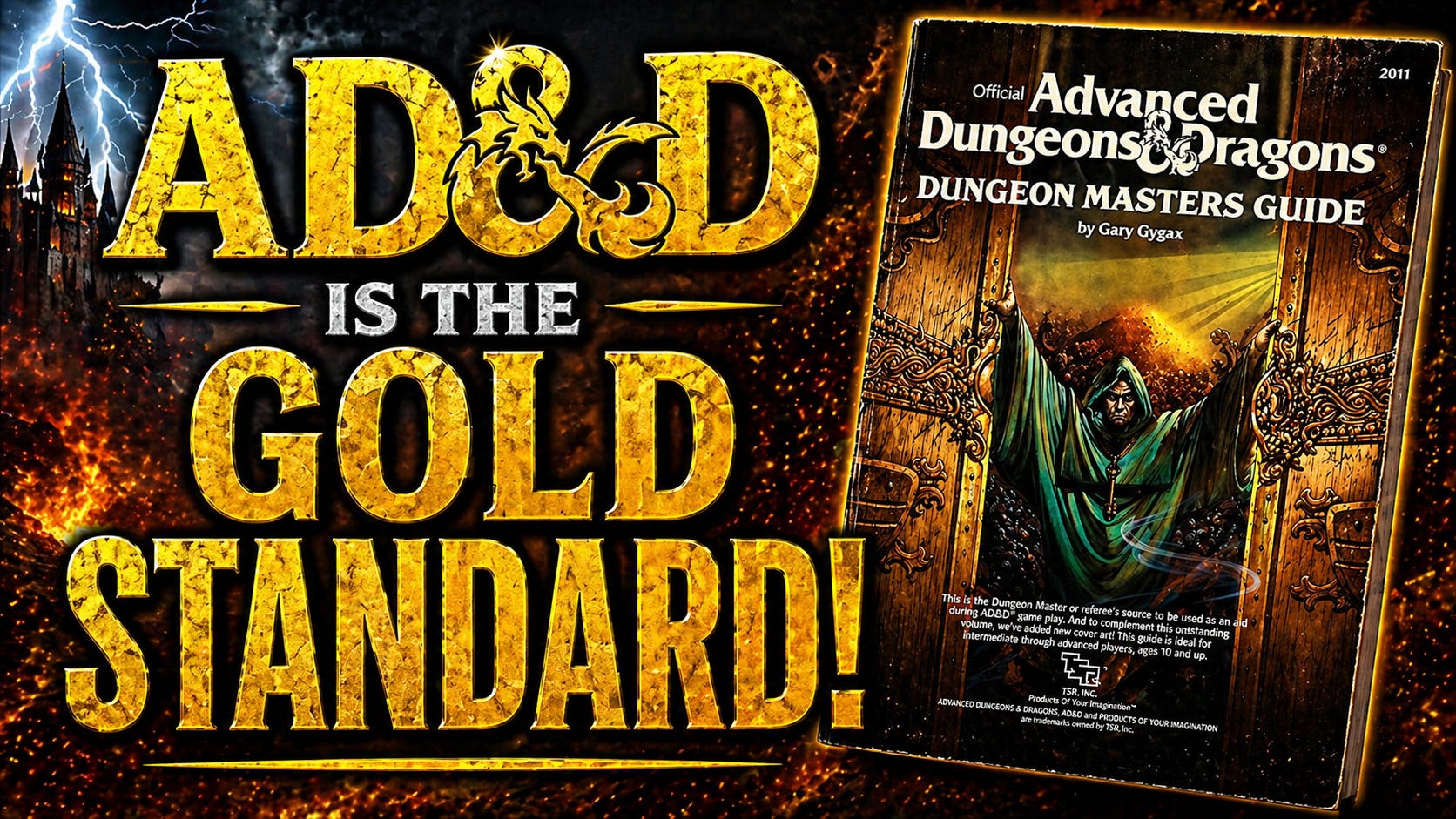
I will say it plain. AD&D is the gold standard of Dungeons and Dragons and will always be...
Not because it is perfect. It is not. Not because every rule is clean. Many are not. Not because it is easy to learn. It is not that either. It is the gold standard because it expected more from you.
AD&D did not hand you the answers to the test, it handed you a torch, a sword, a sack for coins, and a warning. The dungeon did not care about your feelings or how long of a backstory your character has. The wilderness had no level appropriate safe zones. Monsters were not balanced for your comfort. If you won a battle you earned it, or you learned to say, “oh shit! run!”.
Podcast Audio link:
Modern games often protect the player. AD&D respected the player enough to risk failure. There is a difference. Without the possibility of death lurking around every corner, victory means NOTHING. When resources matter, choices matter. When the dungeon can beat you, beating the dungeon feels an accomplishment. AD&D also treated the Dungeon Master like a creator of worlds a weaver of stories, not a referee trapped in a box, saying, “you can’t do that, the book doesn’t cover it”.
Open the Dungeon Masters Guide and you find tables, systems, rulings, advice, strange corners, treasure logic, city details, timekeeping, random encounters, hirelings, morale, disease, gods, planes, tricks, and danger. It is a workshop, not a pamphlet. It throws it all in your lap and says, “Make in your own!”
That book trusted you to think or assumed you had imagination enough to think.
AD&D trusted players too. It assumed you would map, negotiate and learn to run away when needed. It rewarded caution, nerve, and clever play.
That style creates stories people remember for years at the table.. hell I still quote a phrase we said in a game 20 years ago with my friend.
Nobody forgets carrying a cursed idol three sessions because greed beat common sense. Those stories are born from pressure.
AD&D also had weight. Classes felt different. A magic user at level 1 was fragile and scared. At high level, terrifying. Fighters held the line. Clerics were anchors. Thieves lived on nerve and timing. Advancement felt earned because it took time and risk.
Even the flaws became part of its identity.
Yes, some rules were annoying to deal with at time, so we removed them. Yes, some charts were odd. Yes, some rulings made you squint. But the game had teeth, personality, and conviction. It knew what it wanted to be.
Gold standard does not mean flawless.
It means the benchmark.
When people talk about danger, exploration, real campaign worlds, meaningful treasure, tense dungeon crawls, hard choices, and player skill, they keep circling back to AD&D. There is a reason for that.
It still casts a long shadow because it was built on something solid.
AD&D asked more of you.
And because it asked more, it gave more back.
I am a huge fan of AD&D, but BECMI is the only complete game. AD&D needs Birthright to match the C and has nothing for the MI.
The CMI are critical in my experience, and the OSR's obsession with B/X is it's largest failing. Great DMs know this, and do everything I describe below, but AD&D doesn't build it into the game, just assumes it. Dave and Gary did it, talked about it, but only Mentzer and Heard put rules out to support it (hat tip to Allston for the Rules Cyclopedia).
Companion brings everything together, gives a whole new level of meaning to adventures. At B and X tier (all of AD&D) the adventurers see the bandits as enemies to defeat to protect the village. At C tier the PC cuts a deal with them to raid the neighboring kingdom until that land's Lord comes to the table for negotiations. The C tier PC becomes the quest giver, sending people out to resolve the plot holes from years ago in those dungeons and areas that are too low level today. The C tier PC operates in multiple places and levels at once.
At M tier the PC is looking to the future beyond their time in the world. Becoming the best at one thing and leaving behind an impossible new thing in the world making it grander and more special (Paragon). Creating a new church, a fighting school, a kingdom, a philosophy, a school of magic, tradition of music, and ensuring it endures for generations to come (Dynasty). Reincarnating into every class, living the lives of all the people and bringing them together as one against a great enemy then building a monument to the story (Polymath). Permanently removing a great evil from the world, and surviving the blowback from divine level enemies, leaving the world safer for future generations (Epic Hero). Giving the player the ability to rewrite part of the world and leave their mark. A bit of shared world building.
At I tier the player is taking that step forward and seeing the whole tapestry, operating behind the scenes and inspiring others to be greater than they can be alone. Helping those inspired by their M-tier work to reach those heights also. Carry it forward to the next generation.
As I said, Gary and Dave totally did all this. Many good DMs do it. Nothing in AD&D stops you. But only BECMI builds it into the rules and takes you there. Mentzer doesn't get enough credit in my opinion. His work was fantastic.
I once did a project to combine all of OD&D rules, supplements, and articles in Strategic Review and early Dragon magazine, and I ended up with AD&D. There is very little in the AD&D rules that was not written before.
This is why it could be considered the gold standard as it is the accumulation of a large amount of ideas.