


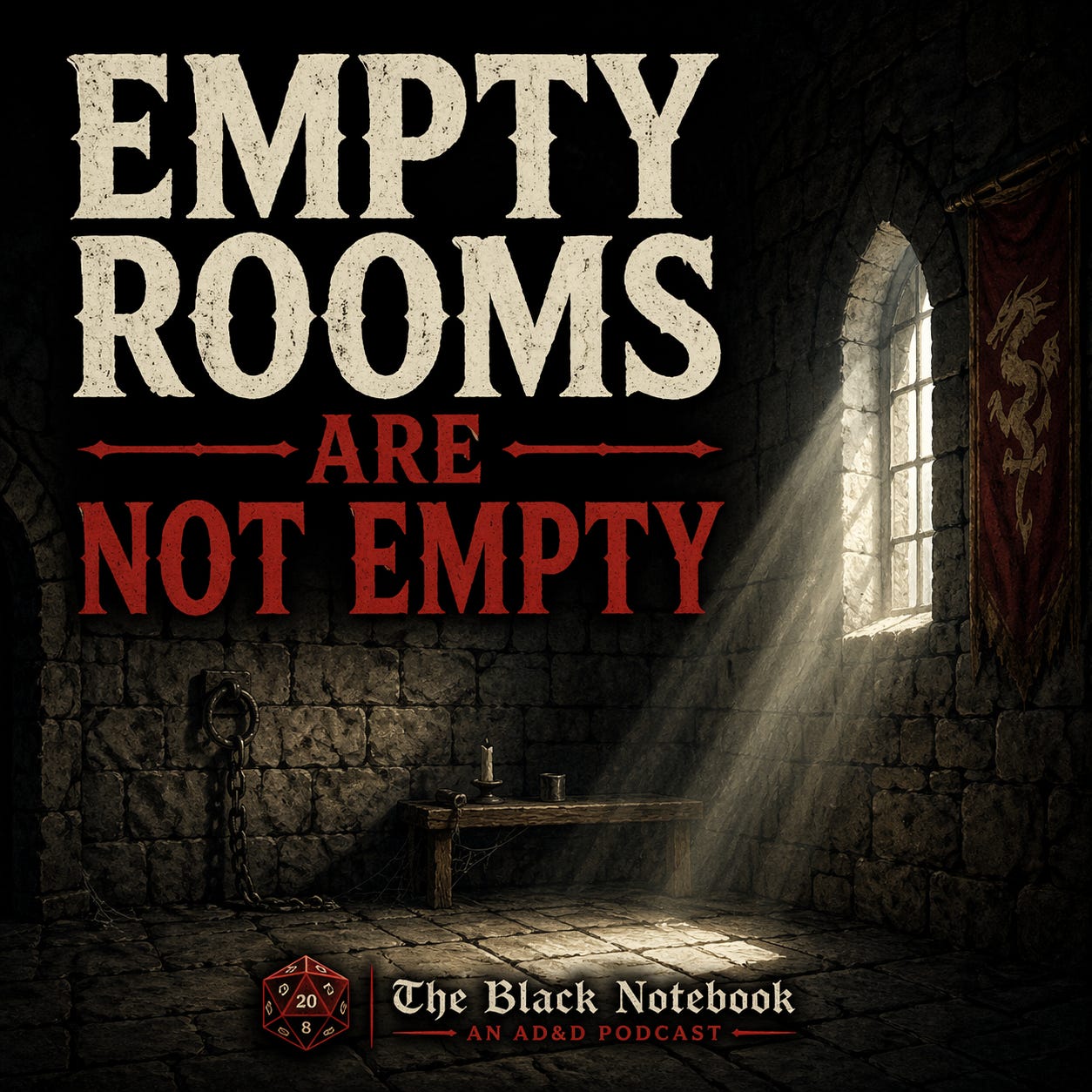
Empty Rooms Are Not Empty, a topic inspired by reading the AD&D Dungeon Master’s Design Kit book.

You walk into a room. Nothing moves. No monster. No treasure. So what is up with this?
A lot of DMs treat empty rooms are dead space, not giving it a second thought because it’s a room that can be easily skipped and that counts as a room for their adventure. I used to do that too. Roll the door, quick glance, move on. But that’s wasted table time.
An empty room is a lot more then just an empty room.
An empty room is information.
Dust on the floor tells you if someone passed through. Thick, undisturbed dust means no traffic. A single set of tracks means someone came in, but did not leave. Now the room matters. Now players slow down and start to question things.
Things that you can say with out saying…
Air.
Stale air means sealed. Moving air means openings. Drafts point to secret doors without saying it out loud. Players start testing walls. Now they are engaged.
Light.
A room that should be dark but is not, that raises questions. Where is the light coming from?
Sound.
A room that absorbs sound feels wrong. A room that echoes too much feels wrong.
Layout. Furniture pushed aside. A chair facing the wall.
I once had a group who spent 30 minutes inspecting a room because I put a chair in the corner, facing the corner. They went nuts trying to figure out why that chair was that way.
You are not filling the room. You are setting a tone.
Here’s how you run it clean at the table.
Give one strong detail, not five
Let players react before adding more (this is very important, be reactionary)
Tie the detail to a question, not an answer
Use the room to point forward or backward (always use it to in a way that will be useful for things to come or something they may have missed)
Never explain it fully (this is the absolute key here!)
Example.
Characters enter a room, it’s dark, there is a table, with some chairs pulled out from it. On the table is a candle that’s half way burned down. The candle feels warm to the touch. The air feels warm in this room.
That’s it.
Players will start asking. Who lit it. How long ago. Where did they go. You didn’t add a monster. You added pressure.
Empty rooms control pacing.
Too many fights and the game feels flat. Too many empty rooms with nothing in them and the game feels pointless. But empty rooms with purpose, that’s where tension builds. That’s where players start to feel watched, hunted, or just unsure.
And that’s what you want.
Because when something finally does happen, it lands harder.
If you are enjoying the podcast and the content on this blog consider joining my Patreon or tipping me!
Listen to the podcast here:

Excellent Ideas that I will use!
Oj, yeah. Now we;re talkin!