


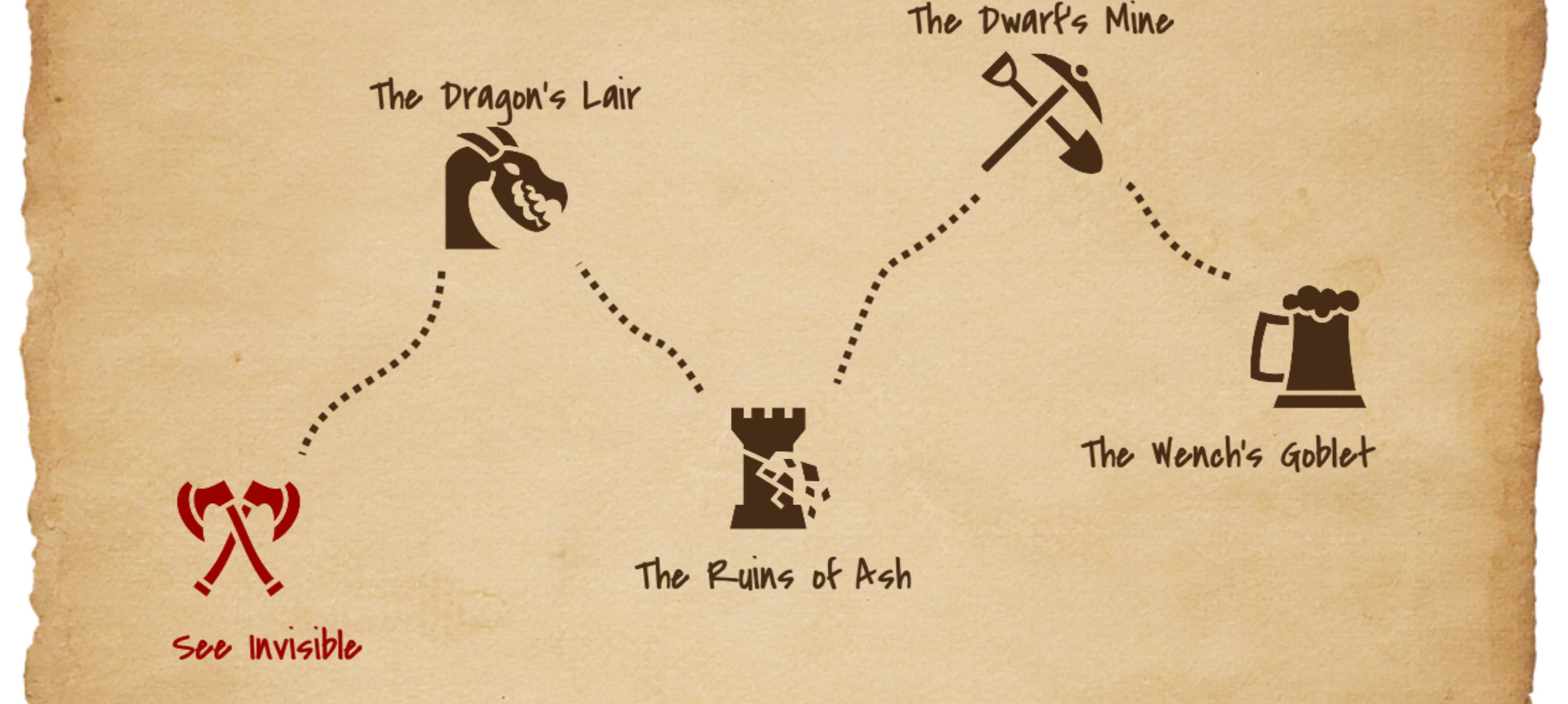
What we see:
A random treasure map from Donjon shows five marked locations. The Dragon’s Lair, The Dwarf’s Mine, The Wench’s Goblet, The Ruins of Ash, and a red mark labeled See Invisible. Dotted trails connect some of the sites, but not all of them. One route runs from the red mark toward the Dragon’s Lair. Another seems to run from the Dragon’s Lair toward the Ruins of Ash. A third runs from the Ruins of Ash toward the Dwarf’s Mine. The Dwarf’s Mine appears tied to the Wench’s Goblet by another route. The map looks simple at first glance, but the layout raises questions about travel, hidden information, and why one spot alone is marked in red.
Okay, today is a just thinking mind exercise… I discovered this treasure map maker, and my mind went crazy. I like stuff like this because it gives you a little taste, enough to make you start to want to know more. Right?
First glance.. it looks like a straight treasure path and kind of boring. It looks too clean to be honest. Running as it is, would be boring. It’s honestly not enough, it needs a lot more. Luckily this is why we do these posts, to explore HOW we can do more, right?
So I stop looking at it like a treasure map and start looking at it like a pressure map.
The first thing that matters is that one location is marked in red and says “See Invisible”. That tells me the map is lying by omission. The red mark is not treasure. It is a tool. Maybe a warning? Or both? ‘Whoever’ made this (yes I know its a random prompt on his site, but I am getting into the mind of the map-maker!) did not think the hidden thing mattered less than the dragon or the mine. They thought it mattered more. Enough to mark it in another color.
That changes the whole use of the map.
So the party has this map, where do they start?
Do they go to the red mark first because it sounds useful. Or do they ignore it because it does not sound like loot?
A lot of groups will ignore it. They hear Dragon’s Lair and Dwarf’s Mine?
Gold. Magic. Action.
So the best part of the map is the part that looks least exciting.
Good. That is useful.
I would make the red location a dangerous side site, not a free buff. Maybe an old shrine where one character can gain the effect for a short time, but only by giving up something real. Blood. Sight in one eye for a day. A memory. A spell slot permanently burned until the curse is lifted. Something mean enough that the players have to stop and think. If they take it, they can see the real trails, the hidden guardians, the false stones, the invisible bridge in the ruins, the dragon’s veiled hoard, all of it. If they refuse, they can still play the map straight, but now they are doing it blind.
That is better already. Oh yes, this is coming together!
Oh yes, before I forget, the dotted lines matter too.
Most groups see lines and think certainty. I would not use them that way. I would treat each dotted route as the safest known route, not the only route. Safe is not the same as good. The safe road takes time. Time means torches, rations, wandering monsters, weather, patrols, rival treasure hunters.
Now the unsafe routes cut distance, but invite other trouble.
Quicksand. Old warding stones. Goblin tolls. A cursed battlefield. Stuff you can choose to risk instead of stuff that just happens to you.
That is where the map starts becoming a game.
Let’s say the party finds this map on a dead body. They know someone wanted these sites linked. They do not know why. They take the known trail toward the Dragon’s Lair because it is marked and because they trust maps too much. Two days in, they lose a mule, burn through extra food, and get seen by the dragon’s outer watchers. They reach the lair tired. That matters. They chose certainty and paid in time.
Another group sees the same map and says no, the Ruins of Ash sit closer by eye, we cut cross country. Fine. Now they save a day and arrive with more supplies, but one hireling falls into an ash sink and breaks a leg, and the group reaches the ruins without the See Invisible clue. They miss the hidden stair and conclude the ruins are empty. They are not empty. They are just unreadable to people who chose speed over information.
That is the kind of thing I want from a map. Not directions. Tradeoffs.
The tavern on the map is what really interests me though. The Wench’s Goblet looks harmless. It is the only social site on the page. That makes players relax. That is exactly why I would make it filthy with motive. Somebody there buys information from failed adventurers. Somebody there sells watered rumors to fresh ones. Somebody there wants the mine reopened because dead dwarves are easier to profit from than living ones. Maybe the innkeeper quietly pushes parties toward the dragon because every dead group leaves gear behind and never comes back to claim it.
That is the darker use of a map like this. Every marked place is not just a location. It is a mouth. It wants something. It needs feeding. Character’s can provide that food, yes?
That is how I would use a random map like this. Not as content already finished. As a machine that makes bad choices expensive and useful choices ugly.
That is enough for a game.