


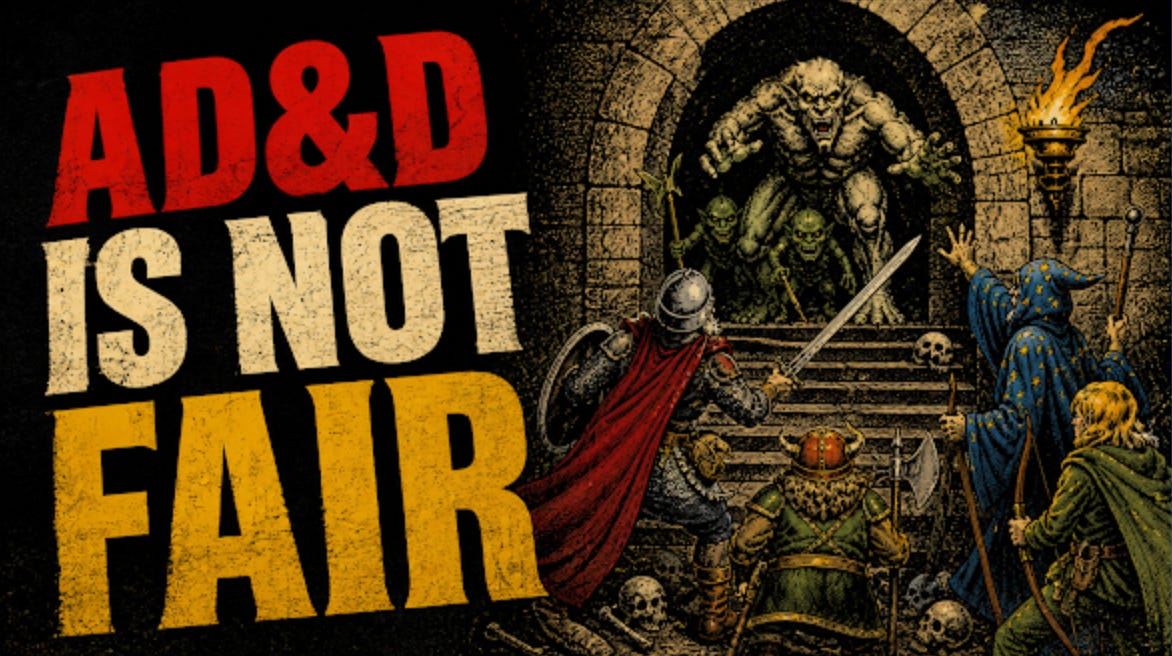
So AD&D was never built around the idea that every fight should be balanced, fair and “level appropriate”. This is one of the biggest, I guess shocks for modern players when they come to the table to play AD&D 1e. You could enter a dungeon, turn a corner, run into a monster that is more powerful then you and get your ass handed to you as you finally realize running was a better choice rather then rushing in like a superhero. The correct answer is in most cases is learn how to run and come back later with a better plan.
That is not bad design. That is the design.
In Gygax’s D&D, the world doesn’t bend to your level, the dungeon does not check your character sheet and says, “oh I better make sure this monster is on the same level as this guy..”. Wandering monsters do not care if the party is wounded, almost dead or running low on spells. The ogre in the next chamber does not step aside because the group needs one more easy encounter before bedtime.
That danger changes how you play.
You start asking better questions. Can we avoid it? Can we bribe it? Can we trap it? Can we turn it against something else? Can we get out before it sees us?
That is where AD&D shines. The fight is only one option, and sometimes its not the best option.
Reaction rolls matter because not every encounter has to become combat. Morale matters because not every enemy fights to the death. Wandering monsters matter because time has weight. Every torch burned, every door forced, every argument in the hallway creates risk.
That is why AD&D feels tense. The game does not promise safety. It promises consequence.
This is also why “unfair” encounters can create better stories. A balanced fight usually ends one way. You fight, spend resources, and win. A dangerous encounter forces choices. The party retreats. The thief scouts ahead. The cleric saves the last spell. The fighter blocks the passage while everyone else escapes. Those moments stick because the players know the danger was real.
AD&D teaches you to respect the dungeon. It teaches you that survival is a victory. Getting out alive with treasure, information, or even one recovered body can mean more than clearing every room.
That style is not for every table. Some players want balance. Some players want every encounter tuned to their party. That is fine. But AD&D plays by a different rule. The world is dangerous first. Fairness comes second, if it shows up at all.
And that is the point.
You are not supposed to win every fight.
You are supposed to learn which fights are worth having.
Support the show on Patreon: https://www.patreon.com/TheEvilDM
Watch on YouTube: https://www.youtube.com/@TheEvilDM
Watch on Rumble: https://rumble.com/TheEvilDM
This was a good discussion but I am going to have to disagree with some aspects, please take this as intended constructive criticism.
The origins of D&D gameplay were dungeon levels, which matched up with character levels and monster levels, this was a method of "balancing" but with the option that characters could stick to easier dungeon levels and earn less xp or delve deeper for more with increased risk.
There are plenty of instances in various rules beyond AD&D that imply balanced encounters; the original rules talk of changing the number of monsters according to party size, (Book III page 11) Holmes Basic page 10 states "The number of wandering monsters appearing should be roughly equal to the strength of the party encountering them", and the established balanced encounter math was defined in AC9 Creature Catalogue (1986) page 6.
I'd have to concede that in AD&D rules there is no implicit mention of balancing encounters, but neither is there any reference to not doing it and leaving it entirely to random rolls, dungeon adventures revert to the classic level math, and the suggestions for running a (wilderness) campaign are to manually populate monsters in the world, in which case it is up to the party to discover and decide whether they are tough enough to confront them, this is player agency not unfair chance.
Finally, I'd propose that even having a balanced encounter in no way changes your original premise of "unfairness", the party could meet a "balanced" monster on their way to the main encounter, do they start expending spells, charges, potions, etc they may need later? Equally they could meet the same "balanced" monster on their way home, when they are out of spells, potions, and low on hit points, these still create challenges and most definitely provide choices to evade rather than fight.