


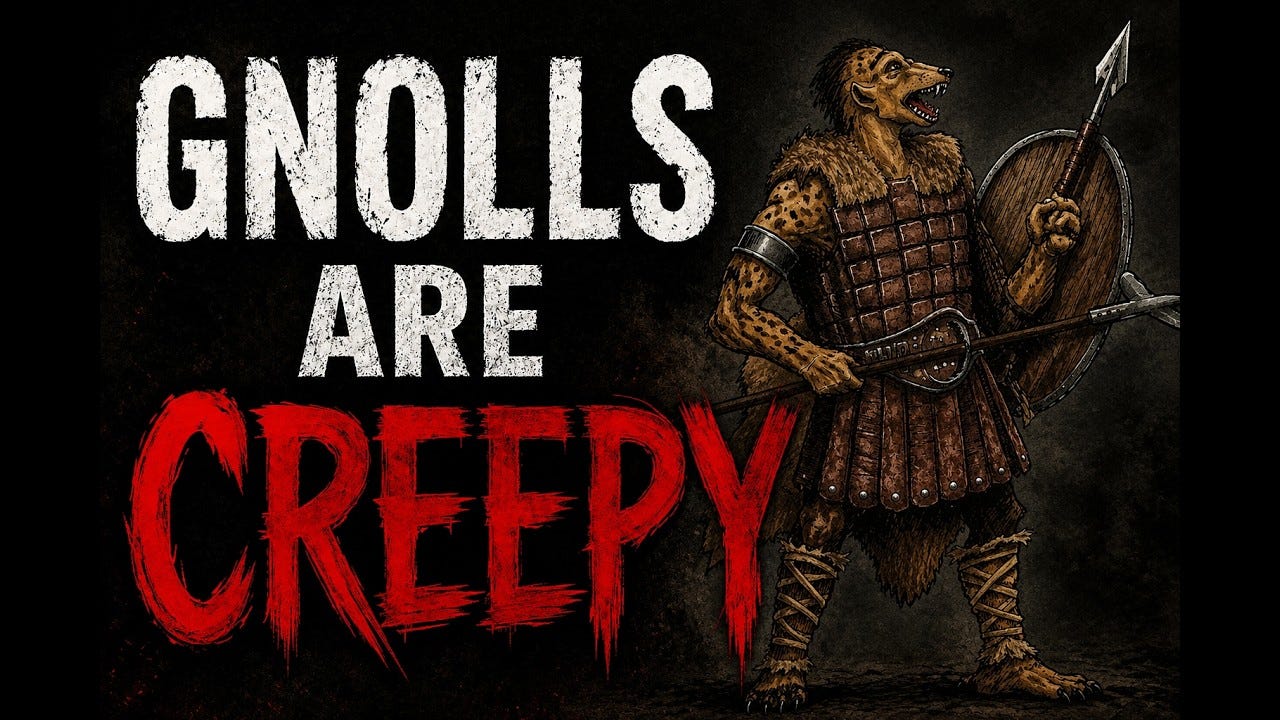
Gnolls in AD&D are more than just hyena men with axes. They sit in this strange place in the game where people underestimate them right up until the moment the party realizes they are being hunted. In this episode, I break down what makes gnolls work so well in old school play, where they came from, how Gary Gygax shaped them in AD&D 1st Edition, and why they feel different from orcs, goblins, and other common humanoids.
We dig into their origins tied back to Lord Dunsany’s “gnoles,” their savage pack behavior, and how to actually run them at the table so they feel dangerous. Not because of inflated stats, but because of pressure, numbers, morale, movement, and fear. A good gnoll encounter should feel messy. Loud. Fast. Like the players walked into something already watching them from the dark.
I also get into gnoll leaders, pack roles, Yeenoghu’s influence, and practical AD&D encounter design. Scouts circling the campfire. Retreating gnolls leading players deeper into danger. Warbands waiting just outside torchlight. This is the kind of stuff that turns a basic humanoid fight into something your group remembers for years.
If your gnolls still feel like hallway filler, this episode might change that.
Great video, and solid advice. It also aligns perfectly with Lord Dunsany's story that originally inspired Gary. How Nuth Would Have Practiced His Art Upon the Gnoles.
> " No track led up to the sinister gloom of the trees, either of men or cattle; not even a poacher had been there snaring elves for over a hundred years. You did not trespass twice in the dells of the gnoles. And, apart from the things that were done there, the trees themselves were a warning, and did not wear the wholesome look of those that we plant ourselves.
The nearest village was some miles away with the backs of all its houses turned to the wood, and without one window at all facing in that direction. They did not speak of it there, and elsewhere it is unheard of." <
So the locals are so terrified that they refuse to speak about the Gnoles, and don't even have Windows facing that direction. Then your advice about watching for the right moment and pouncing to drag someone away .. well that happens.
> " But the gnoles had watched him through knavish holes that they bore in trunks of the trees, and the unearthly silence gave way, as it were with a grace, to the rapid screams of Tonker as they picked him up from behind—screams that came faster and faster until they were incoherent. And where they took him it is not good to ask, and what they did with him I shall not say. " <
There are two other things worth mentioning about early vs later gnolls. In Greyhawk, their original deity was Gorelik a god of hunting. Yeenoghu came later with Forgotten Realms and is a demon lord not a god, and he stole gnolls from Gorelik who fell to the level of demigod as a result. I ran a campaign based on this, with a cult dedicated to restoring Gorelik to full divine status. There's gold in Gary's ideas for anyone who wants to grab it.
Also in BECMI, module B4 The Lost City, most miss it, but gnolls are not just an early game threat, they destroyed the whole civilization driving the Cynidiceans under ground.
In BECMI they were created by an ancient civilization of mages called the Nithians. The mages didn't like war or strategy, so they made gnolls to be a force they could just drop a few warbands into an enemy kingdom and wait. The gnolls would breed and spread and weaken the kingdom. Picking it apart over time. Eventually the gnolls would be stronger than whatever remains, band into a horde and go for the kill, leaving only ruins. Unfortunately, they also did this to the mages.
So there's a whole gnolls apocalypse campaign too. Start with B4 as a warning or foreshadowing, then ratchet it up. Merchants start avoiding the area, wilderness reclaims abandoned farms, towns and villages lost, then a horde outside the castle. Unless the PCs stop it.
Thought you can never unthink: Devo’s cover of “Working in the Coal Mine,” only reworded with “Working in the Gnoll Mine.”
You’re welcome.